Key Takeaways
- Sober October participation has grown 152% year-over-year, making it the largest alcohol-free challenge movement globally
- The first 3-4 days are hardest due to habit disruption -- having a plan for Friday and Saturday nights is critical
- Tracking your progress daily increases completion rates by up to 40% compared to casual participation
- 80% of Sober October participants report continuing reduced drinking after October ends
- Start planning in September: remove alcohol from home, tell at least one friend, and identify 3-5 alcohol-free activities you enjoy
What Is Sober October?
Sober October started as a fundraising campaign for cancer prevention in the UK, but it’s evolved into something much bigger: a global movement of people choosing to take a break from alcohol for 31 days. No labels, no judgment, no commitment beyond October. Just you, a calendar, and the question: “What happens if I don’t drink for a month?”
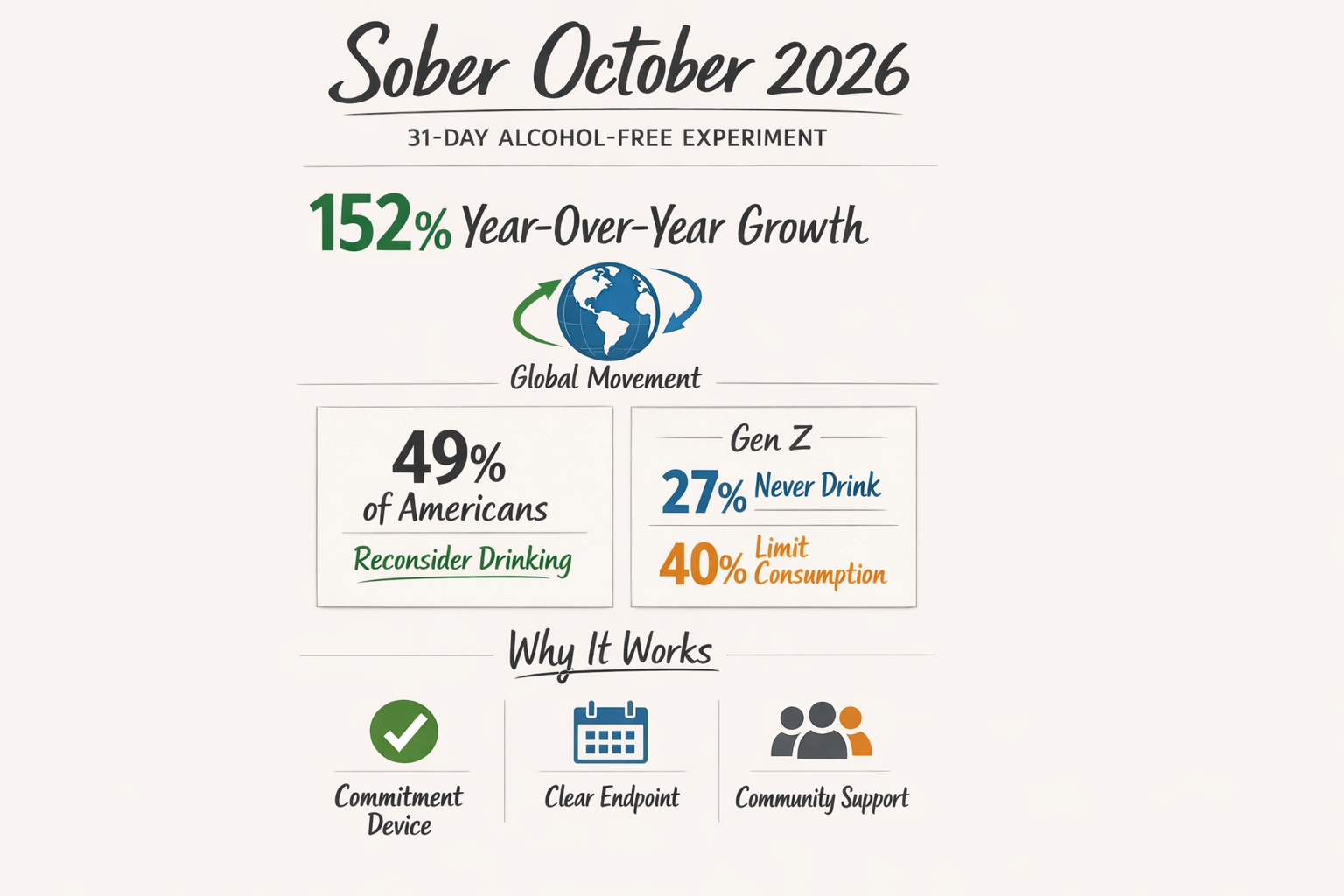
In 2026, this isn’t a niche experiment anymore. Sober October participation has grown 152% year-over-year, making it the largest alcohol-free challenge movement globally. That growth reflects a fundamental shift in how people think about alcohol.
The sober-curious movement is reshaping alcohol culture. According to recent surveys, 49% of Americans are actively reconsidering their relationship with drinking. Gen Z is leading this shift, with 27% of people aged 21-24 reporting they never drink and 40% intentionally limiting consumption. This isn’t about addiction recovery or hitting rock bottom. It’s about choice, curiosity, and seeing what life feels like on the other side of the wine glass.
Sober October offers the perfect low-commitment entry point. It’s a defined challenge with a clear endpoint, which makes it psychologically easier than “quitting forever.” You’re not swearing off alcohol permanently. You’re running an experiment on yourself for 31 days. No labels required.
Why Sober October Works
There’s a reason time-limited challenges like Sober October succeed where vague goals like “drink less” often fail. The psychology is simple but powerful.
The Power of a Commitment Device
Behavioral economists call Sober October a commitment device — a voluntary constraint that helps you achieve a goal by eliminating moment-to-moment decision-making. When you commit to Sober October, you’re not deciding whether to drink every time someone offers you a glass of wine. The decision is already made: you’re doing Sober October. That clarity eliminates decision fatigue and removes the mental negotiation that often leads to giving in.
If you’re exploring what it means to be sober-curious beyond just one month, our complete sober curious guide covers everything from mental health to social strategies for making long-term changes.
Compare that to “I’m trying to drink less.” Every invitation becomes a negotiation. Is tonight a drinking night? How much is too much? Does this situation count? That ambiguity creates cracks for old habits to slip through. Sober October removes the ambiguity entirely.
The 31-Day Sweet Spot
A month is long enough to notice real changes — in your sleep, your energy, your mood, your wallet — but short enough to feel manageable. Research on habit formation shows it takes 18 to 254 days to form a new habit, with an average of 66 days. Sober October gives you half that timeframe, which means you won’t fully rewire your drinking habits, but you will disrupt them enough to gain valuable perspective.
By day 20 or 25, you start asking different questions. Do I actually miss drinking, or just the social ritual? Did alcohol really help me relax, or did I just believe it did? Those insights are the real value of Sober October. You’re not just abstaining. You’re gathering data about your own life.
The Community Effect
Sober October isn’t a solo endeavor. Thousands of people across the world are doing it at the same time, posting on social media, encouraging each other, sharing strategies. That sense of shared commitment creates accountability and normalizes the experience. You’re not weird for not drinking in October. You’re part of a movement.
Social media has amplified this community aspect. Instagram, TikTok, and Reddit threads about Sober October create spaces where people share their progress, celebrate milestones, troubleshoot challenges, and laugh about the absurdity of how much alcohol dominates social life. That peer support can be more powerful than willpower alone.
What to Expect: Week by Week
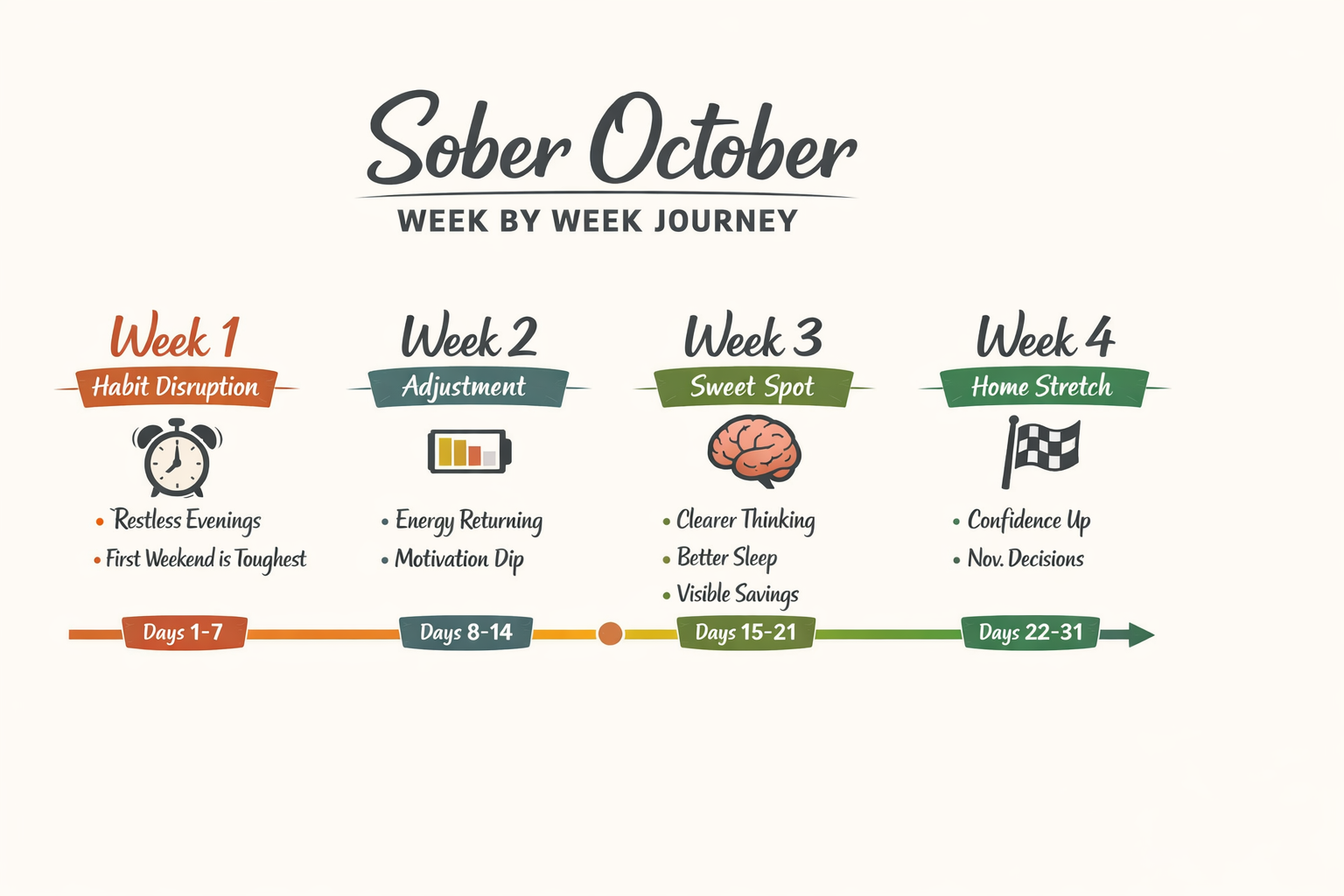
Knowing what to expect makes Sober October significantly easier. Here’s the realistic timeline, not the sanitized one.
Week 1 (Days 1-7): The Habit Disruption Phase
The first week is the hardest. Not because of physical withdrawal for most people, but because you’re breaking patterns you’ve followed for years.
What you’ll feel:
- Days 1-3: Restlessness, especially in the evenings. If you usually wind down with a drink, you’ll feel the absence acutely. Your brain is looking for the routine it knows.
- Days 4-7: Friday and Saturday are the toughest days for most people. These are the traditional drinking nights, and social pressure peaks. Declining invitations or navigating sober socializing feels awkward at first.
- Sleep disruption: Ironically, your sleep might get worse before it gets better. If you’ve been using alcohol as a sleep aid, your body needs to relearn how to fall asleep naturally.
How to navigate it:
- Plan your Friday and Saturday nights in advance. Don’t leave them open-ended. Schedule a specific activity — movie night, dinner with a supportive friend, a long hike Saturday morning that makes Friday drinking unappealing.
- Stock your fridge with alternatives. Sparkling water, herbal tea, fancy mocktails, kombucha, NA beer. The ritual of drinking something matters almost as much as what’s in the glass.
- Go to bed earlier than usual. The first week, you’ll have more free time than you expect (no lingering over drinks, no staying up late because you had wine with dinner). Use that time for sleep.
Week 2 (Days 8-14): The Adjustment
The novelty of Sober October has worn off. This is the “boring” phase where the challenge isn’t dramatic anymore, just… persistent.
What you’ll feel:
- Energy returning: Most people notice increased energy around day 10-12. You’re sleeping better (REM sleep starts recovering after 7-10 days without alcohol), waking up clear-headed, avoiding the low-grade hangover fatigue.
- The “is this it?” feeling: The big insights haven’t arrived yet. You just feel… fine. Maybe a little more rested, but not transformed. This is when people get bored and consider quitting the challenge.
- Less social pressure: By week 2, your friends have stopped asking “Why aren’t you drinking?” You’ve normalized it. That gets easier.
How to stay motivated:
- Track small wins. Notice the mornings you wake up without a headache. The Saturday you spent hiking instead of nursing a hangover. The extra $50 in your bank account.
- Connect with the Sober October community. When motivation dips, reading other people’s experiences reminds you that you’re not alone in the boring middle.
- Add novelty elsewhere. Try a new workout class, explore a neighborhood you’ve never visited, cook a complicated recipe. Channel the restlessness into something new.
Week 3 (Days 15-21): The Sweet Spot
This is when Sober October gets good. The physical and mental benefits become undeniable. What to expect during your 31-day challenge — see our 30-day benefits guide for a comprehensive breakdown.
What you’ll feel:
- Noticeable physical improvements: Skin looks clearer (alcohol is dehydrating and inflammatory). Energy is consistently higher. Digestion improves. Many people lose a few pounds without changing their diet.
- Mental clarity: Brain fog lifts. Focus improves. You make decisions faster and feel more present in conversations.
- Financial savings becoming visible: Three weeks of not buying drinks adds up. Whether it’s $75 or $300, seeing that number makes the challenge feel rewarding in a tangible way. For a detailed breakdown of exactly how much money you’ll save, our calculator shows hidden costs most people don’t track.
Common thoughts:
- “I forgot how good mornings can feel.”
- “Do I even miss drinking, or just the habit?”
- “I’ve saved enough money to buy [specific thing I’ve been wanting].”
How to ride the momentum:
- Celebrate week 3 as a milestone. You’re two-thirds done. That’s a real accomplishment.
- Reflect on what’s changed. Journal or talk with a friend about what you’ve noticed. Articulating the benefits makes them more real.
- Start thinking about October 31st. Will you have a drink on November 1st? Wait a few more days? Keep going? You don’t have to decide yet, but start considering it.
Week 4 (Days 22-31): The Home Stretch
You can see the finish line. For many people, this final week brings unexpected emotions.
What you’ll feel:
- Pride and momentum: You’re about to complete a 31-day challenge. That’s a big deal. The sense of accomplishment builds as the month winds down.
- Questioning old habits: By day 25 or 28, many people start questioning whether they want to go back to their previous drinking patterns. The idea of a Friday night hangover suddenly seems less appealing.
- The “do I even want to go back?” moment: This is the most common realization in week 4. You’re not necessarily ready to quit forever, but the automatic return to drinking feels less automatic.
How to finish strong:
- Don’t coast through the final days. It’s easy to think “I’ve made it this far, I can slack off now.” Stay intentional.
- Plan how you’ll handle November 1st. Will you drink? If so, how much? Or will you extend the experiment? Having a plan prevents impulsive decisions.
- Acknowledge what you’ve learned. The data you’ve gathered over 31 days — about your energy, mood, social life, finances — is powerful. Don’t dismiss it.
Your Sober October Toolkit
Preparation dramatically increases your chances of completing Sober October. Here’s how to set yourself up for success before October 1st arrives.
Clear Alcohol from Your Home (Or Designate a “No-Go” Zone)
If you live alone, remove all alcohol from your home in September. You don’t need to pour it out — give it to friends, store it at someone else’s place, or lock it in a cabinet you commit not to opening. The goal is removing the immediate temptation.
If you live with people who drink, designate a specific cabinet or shelf as the “no-go zone” where alcohol lives. Out of sight, out of mind works better than willpower alone.
Stock Alternatives
The ritual of drinking something in the evening matters. Stock your fridge with satisfying alternatives:
- Non-alcoholic beer: Athletic Brewing, Heineken 0.0, and Partake all make surprisingly good NA beers.
- Sparkling water with bitters: A splash of Angostura bitters in sparkling water feels more sophisticated than plain water.
- Kombucha, shrubs, fancy sodas: Experiment with flavors that feel special, not like settling.
- Herbal tea with ritual: If you used wine as a wind-down signal, replace it with a specific tea you only drink in the evening.
The goal isn’t to replicate alcohol’s effects. It’s to maintain the ritual that signals “this is relaxation time.”
Tell at Least One Person
Accountability increases completion rates dramatically. Tell a friend, partner, or family member that you’re doing Sober October. Ask them to check in on you during the toughest days (typically the first weekend).
You don’t need to announce it to everyone. But having at least one person who knows and supports you makes a measurable difference.
Plan Your First Sober Friday Night
Don’t leave the first Friday of October open-ended. Make concrete plans. Go to a movie. Host a game night. Sign up for a Saturday morning yoga class that makes Friday night drinking unappealing.
The first sober Friday sets the tone for the rest of the month. Nail that one, and subsequent weekends get easier.
Download a Tracker
Tracking your progress daily creates powerful accountability and helps you spot patterns you’d otherwise miss. Soberly is a free, private sobriety tracker that counts your days, hours, and minutes. It’s built for exactly this kind of challenge.
You open the app, you see your counter ticking up in real-time, and you get a hit of motivation. On day 17 when you’re tempted to quit, seeing “407 hours sober” makes you less likely to reset that counter.
Social Survival Guide
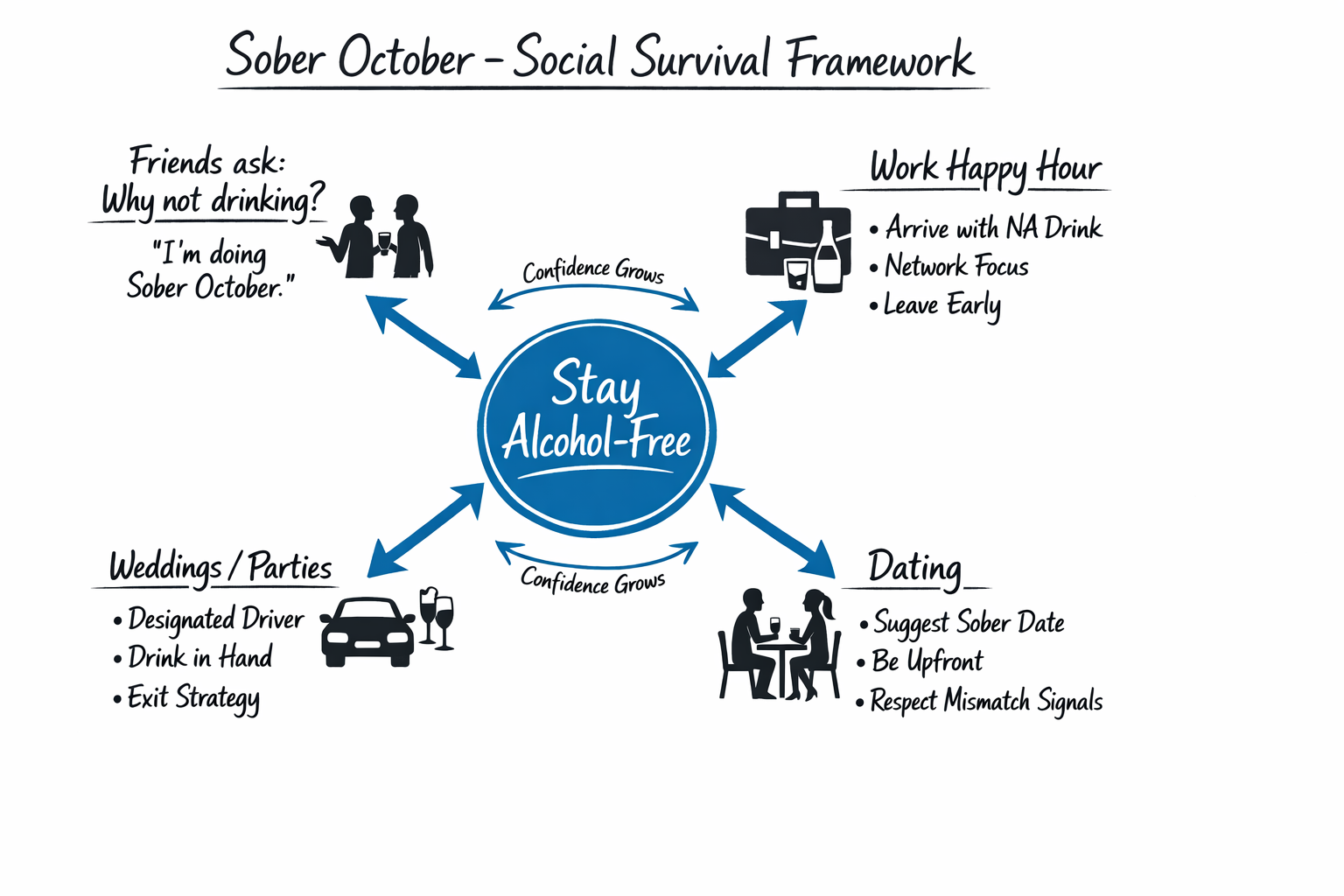
Navigating social situations without drinking is the biggest challenge most people face during Sober October. Here’s how to handle the most common scenarios.
”Why Aren’t You Drinking?”
This question will come up. A lot. Here are four responses that work:
1. The simple truth: “I’m doing Sober October.” Most people know what that is now, and it ends the conversation immediately.
2. The health angle: “I’m focusing on sleep/training/health this month.” No one argues with health goals.
3. The deflection: “I’m taking a break. Can I get your opinion on [change subject]?” Answer briefly, then shift topics fast.
4. The question-as-answer: “Why, do I seem like I need one?” Delivered with a smile, this gently challenges the assumption that everyone should be drinking.
Practice one or two of these so they roll off your tongue automatically. The less you hesitate, the less people press.
Work Happy Hours and Networking Events
Work events are tricky because there’s social and professional pressure. For comprehensive strategies on navigating every social situation sober, from dating to weddings, see our guide on how to socialize without drinking. Strategies:
- Arrive with a drink already in your hand. Get a soda or sparkling water immediately so no one offers you alcohol.
- Focus on the networking, not the drinking. You’re there to make connections, not drink. Reframe the event around its actual purpose.
- Leave earlier than you normally would. You’re not obligated to stay through the entire event. Make your rounds, have your conversations, and exit while everyone else is on drink two or three.
The surprising benefit: people remember the sober person at the work event more than the person who had three beers and got sloppy. You’re more likely to make a good impression.
Weddings and Parties
These are high-pressure drinking environments. Here’s how to survive them:
- Be the designated driver. This gives you an unassailable excuse not to drink, and it helps a friend.
- Hold a drink at all times. NA beer, tonic water with lime, anything that looks like it could be alcoholic. This stops people from offering you drinks.
- Dance, talk to people, stay busy. The more engaged you are in the actual socializing, the less you think about drinking.
- Have an exit strategy. If the event becomes overwhelming, give yourself permission to leave. You don’t owe anyone an explanation.
Dating During Sober October
Dating sober feels vulnerable. You’re showing up as your full self, no liquid courage to smooth the edges. But that vulnerability is exactly why sober dating often leads to better connections.
- Suggest non-drinking first dates. Coffee, brunch, hiking, museum visits, daytime activities. This normalizes sobriety from the start.
- Be upfront about Sober October. On a first date, mention it casually: “I’m doing Sober October, so I’ll stick with coffee.” Most people respect it.
- If they push back, that’s information. Someone who can’t imagine a date without alcohol probably isn’t a great match if you’re exploring a sober lifestyle.
The Pressure from Friends Who Drink
Some friends will be supportive. Others will feel weirdly threatened by your Sober October, as if your sobriety is a judgment on their drinking. It’s not, but their discomfort is real.
How to handle it:
- Don’t preach. You’re doing Sober October for yourself, not to convert anyone. The more neutral you stay, the less defensive they’ll get.
- Suggest sober activities. Instead of meeting at a bar, suggest a hike, a concert, a coffee shop. This shifts the dynamic.
- Set boundaries if needed. If someone repeatedly pressures you to drink, it’s okay to say “I need you to stop asking me that” or skip hangouts with them during October.
True friends will adapt. The ones who can’t respect your choice reveal something about the friendship’s foundation.
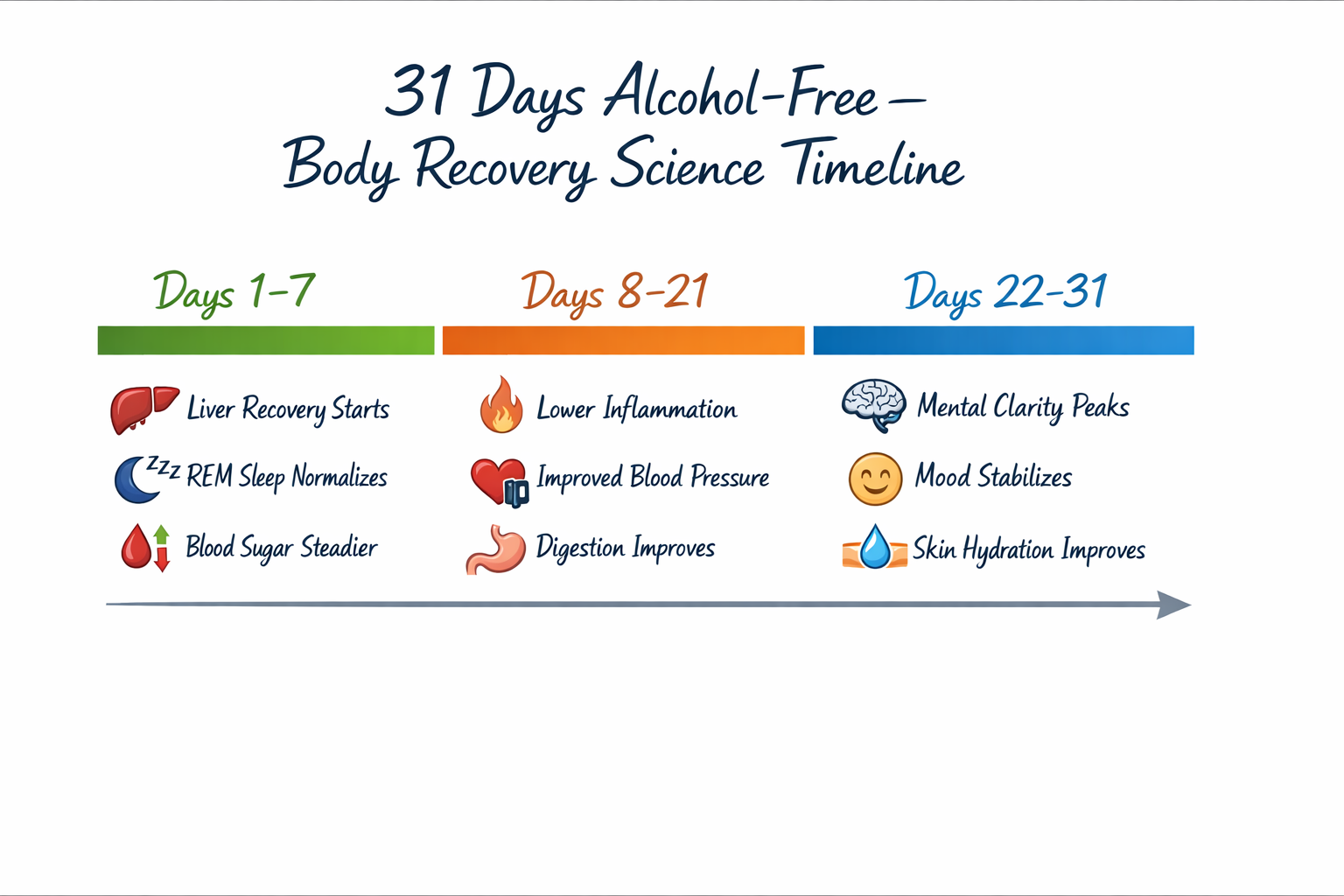
The Science: What Happens to Your Body During 31 Days Alcohol-Free
Understanding the physical changes makes Sober October feel purposeful, not just performative. Here’s what’s happening inside your body during those 31 days.
Days 1-7: Detox and Early Repair
- Liver enzyme improvement begins: Your liver starts clearing the backlog of metabolic byproducts from alcohol. Research shows liver enzyme levels can improve within the first week of abstinence.
- Sleep quality starts to recover: Alcohol suppresses REM sleep, the restorative phase where your brain consolidates memories and processes emotions. By day 3-7, REM sleep begins to normalize.
- Blood sugar stabilizes: Alcohol disrupts blood sugar regulation. Within a few days, your energy levels become more consistent throughout the day.
Days 8-21: Physical Benefits Accelerate
- Inflammation decreases: Alcohol is inflammatory. By week 2-3, chronic low-grade inflammation starts to decline, which shows up as clearer skin, less puffiness, and reduced joint aches.
- Blood pressure improves: Studies show that even moderate drinkers see blood pressure improvements after two weeks of abstinence.
- Digestion improves: Alcohol irritates the gut lining. By week 3, many people notice less bloating, more regular digestion, and reduced heartburn.
- Weight loss (for some): Cutting alcohol eliminates hundreds of empty calories per week. Combined with better sleep (which regulates hunger hormones), many people lose 3-5 pounds during Sober October without changing their diet.
Days 22-31: Mental and Cognitive Gains
- Mental clarity peaks: Brain fog clears. Focus, memory, and decision-making improve. This is partly due to better sleep and partly due to the absence of alcohol’s neurotoxic effects.
- Mood regulation improves: Alcohol disrupts neurotransmitters like GABA and serotonin, which regulate mood. After 3-4 weeks, many people notice more emotional stability and less anxiety.
- Skin hydration: Alcohol is dehydrating. By the end of the month, skin looks noticeably more hydrated and vibrant.
The physical benefits are measurable. The mental shift — realizing you don’t need alcohol to relax, socialize, or have fun — is the real transformation.
Track Your Sober October Progress
Tracking a 31-day challenge is exactly what Soberly was built for. This is where a dedicated sobriety tracker becomes genuinely valuable.
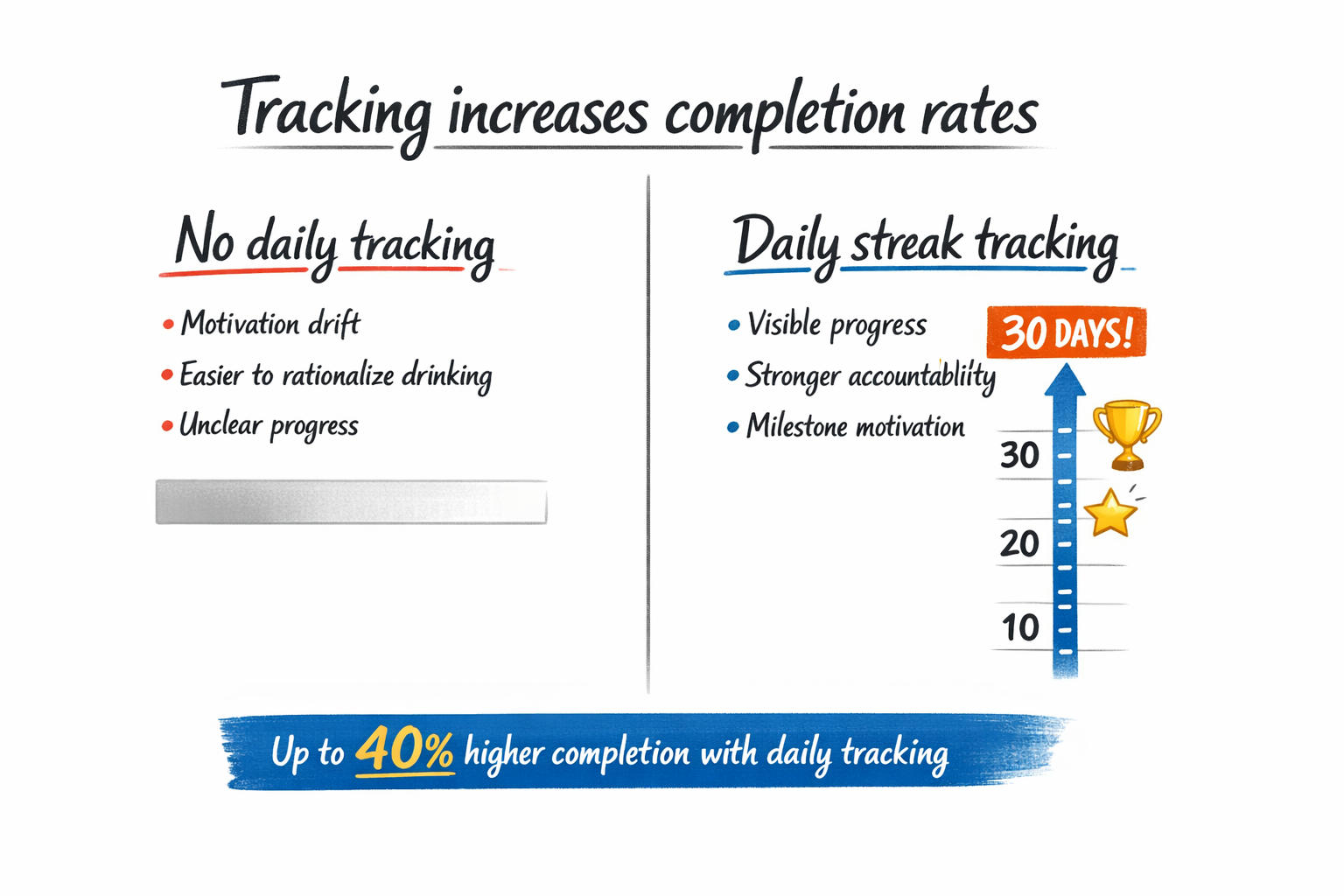
Here’s why tracking matters: research shows that tracking your progress daily increases completion rates by up to 40% compared to casual participation. When you can see your progress in real-time — 3 days, 10 days, 400 hours — it creates motivation that willpower alone doesn’t provide.
Soberly makes this effortless. You set your sobriety start date (October 1st), and the app counts up automatically. Every time you open it, you see:
- Days, hours, and minutes sober
- Milestones as you hit them (1 week, 2 weeks, halfway point)
- A visual representation of your streak
No social pressure to share. Just you and your counter, watching the numbers climb.
Here’s the psychological effect: On day 18 when you’re at a party and someone offers you a drink, you don’t think “Should I have one?” You think “Do I want to reset a counter that’s currently at 432 hours?” That shift in framing — from abstract goal to concrete number — makes saying no significantly easier.
Download Soberly (free and private): https://getsoberly.com
And here’s the surprising part: many people keep using Soberly after Sober October ends. Once you see how good 31 days feels, extending it becomes appealing. The tracker you used for a challenge becomes the tracker you use for a lifestyle.
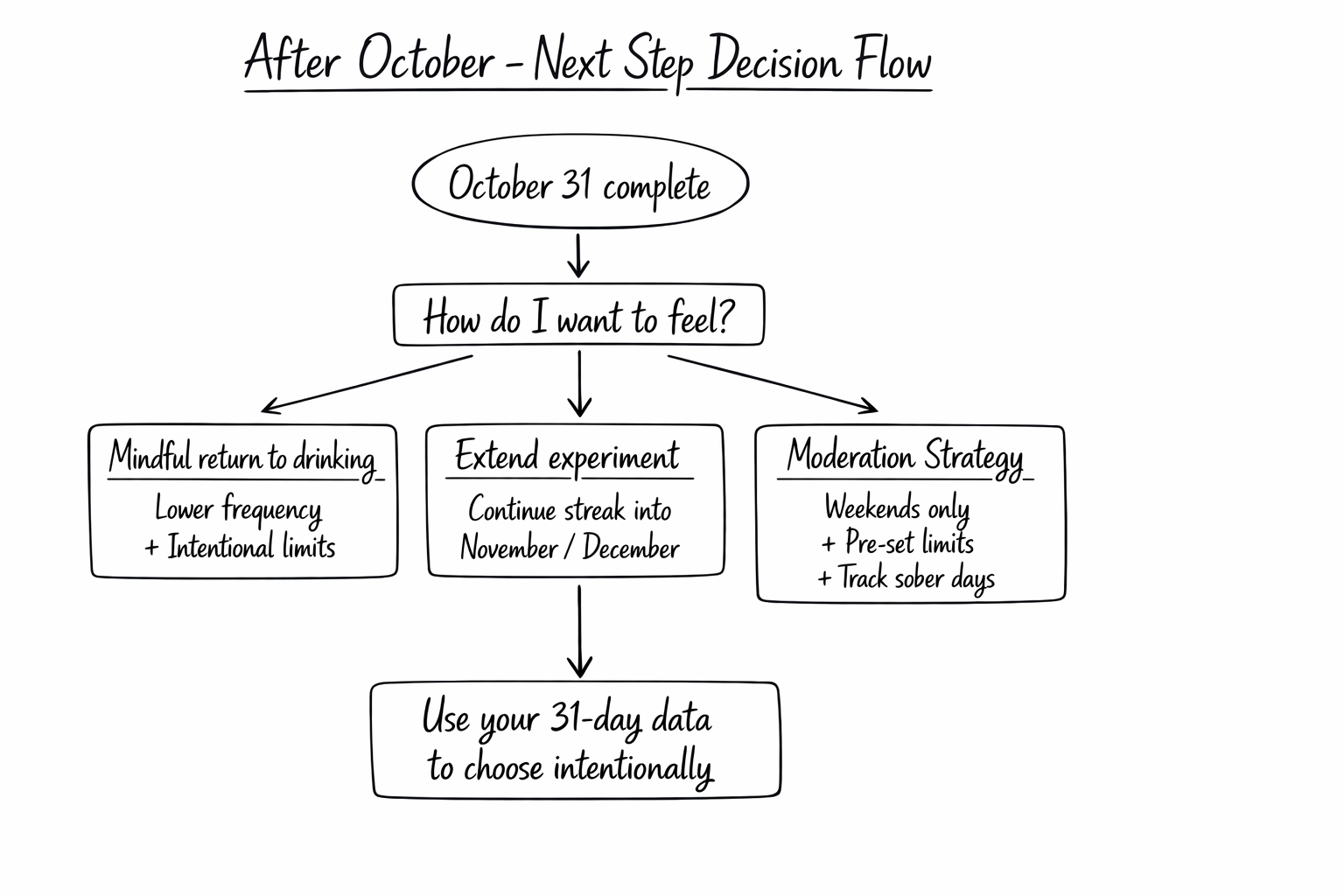
What Happens After October?
October 31st arrives. You’ve completed 31 days without alcohol. Now what?
The surprising statistic: 80% of Sober October participants report continuing reduced drinking after October ends. This isn’t a challenge that ends and gets forgotten. For most people, it fundamentally shifts their relationship with alcohol.
Option 1: Return to Drinking (With New Perspective)
You can return to drinking after Sober October. Many people do. But here’s what’s different: you now have 31 days of data about how you feel without alcohol.
You know what it’s like to wake up clear-headed for a month. You know how much money you save. You know you can socialize, relax, and have fun without drinking. That knowledge changes how you drink going forward, even if you choose to drink again.
Many people adopt what’s called “mindful drinking” — they still drink, but less frequently, in smaller amounts, and with more intentionality. Sober October doesn’t have to be a gateway to permanent sobriety. It can simply be a reset that helps you drink more consciously.
Option 2: Extend the Experiment
Some people hit day 31 and think “I’m not ready to stop.” The benefits feel too good to give up. Energy, sleep, mental clarity, financial savings — why reset now?
Extending Sober October into November (or beyond) doesn’t require a big declaration. You don’t have to say “I’m quitting forever.” You can simply say “I’m going to see how December feels too.” No labels required.
This is where Soberly continues to be useful. Your counter doesn’t stop at 31 days. It keeps going. 45 days. 60 days. 100 days. Each milestone reinforces the decision to keep going.
Option 3: Try Moderation Strategies
After 31 days sober, some people want to drink again but in a more controlled way. Strategies that work:
- Limit drinking to weekends only. No weeknight drinks.
- Set a drink limit before events. Decide in advance: “I’ll have two drinks and then switch to soda.”
- Use Soberly to track alcohol-free days. Even if you drink occasionally, tracking your sober streaks keeps you accountable.
The key insight from Sober October: you now have proof that you can control drinking, rather than drinking controlling you. That’s a powerful shift.
The Real Question to Ask Yourself
On November 1st, don’t ask “Should I drink?”
Ask: “How do I want to feel?”
If you want to feel how you felt on day 28 of Sober October — rested, clear-headed, present — that’s information. If you genuinely want a drink and feel confident you can enjoy it without falling back into old patterns, that’s information too.
You’ve run the experiment. Now you get to interpret the results and decide what comes next. No one else can tell you the right answer. The data is yours.
Frequently Asked Questions
Can I have just one drink during Sober October?
Technically, you can do whatever you want. But the challenge is called “Sober October,” not “Almost Sober October.”
The power of the challenge is its clarity. One drink breaks the streak and reintroduces the mental negotiation: “If I can have one, why not two?” That ambiguity is exactly what the challenge eliminates.
If you slip up, don’t catastrophize. You don’t have to wait until next October. Reset your counter and start again the next day. The goal is progress, not perfection.
What if I slip up?
If you drink during Sober October, you have two choices:
- Reset and keep going. Start your counter over the next day. An imperfect Sober October is still valuable.
- Call it a learning experience. Figure out what triggered the slip — stress, social pressure, boredom — and plan how to handle it better next time.
Beating yourself up doesn’t help. Learning from it does.
Is Sober October just for heavy drinkers?
Absolutely not. Sober October is for anyone curious about what life feels like without alcohol. You don’t need to have a “problem” to benefit from a break.
In fact, moderate drinkers often gain the most from Sober October because they don’t expect it to make a difference — and then it does. The weekend wine habit that seemed harmless reveals itself as something that was affecting sleep, energy, and mood more than they realized.
What about social events? Will I lose friends?
The common fear: “If I don’t drink, I’ll be boring and people won’t want to hang out with me.”
The reality: If your friendships only exist around alcohol, Sober October reveals that. And that’s useful information.
Most friendships survive Sober October just fine. The ones that struggle often weren’t as deep as you thought. And the benefit: you discover which relationships are built on genuine connection versus shared drinking habits.
What if I feel anxious or depressed without alcohol?
If you’ve been using alcohol to manage anxiety or depression, removing it can surface those feelings more intensely. This is actually important information.
Alcohol masks symptoms; it doesn’t solve the underlying issue. If anxiety or depression spikes during Sober October, that’s a sign those issues need proper treatment — therapy, medication, lifestyle changes — not self-medication with alcohol.
Consider Sober October a diagnostic tool. If mental health struggles emerge, seek professional support. That’s not failure. That’s using the challenge to identify something that needs attention.
Can I do Sober October if I drink heavily every day?
If you drink heavily daily (8+ drinks per day), quitting cold turkey can be medically dangerous. Severe alcohol withdrawal can cause seizures, hallucinations, and life-threatening complications.
In this case, consult a healthcare provider before starting Sober October. You may need medical supervision or a gradual reduction plan rather than stopping abruptly.
Sober October is a lifestyle challenge for most people, not a medical detox program. If you suspect you have physical dependence on alcohol, prioritize safety over participation in the challenge.
Your Sober October Starts Now
Sober October 2026 is an experiment in what life could feel like without alcohol. Not forever. Just 31 days.
You don’t need to have a drinking problem to benefit. You don’t need to make a permanent decision about your relationship with alcohol. You just need to commit to 31 days of curiosity.
What will you discover? Maybe you’ll sleep better. Maybe you’ll save $200. Maybe you’ll realize that the social anxiety you thought alcohol fixed was actually made worse by alcohol. Maybe you’ll finish October proud of yourself for reasons you didn’t expect.
The only way to know is to try.
Stock your fridge with alternatives. Tell a friend. Download Soberly. Mark October 1st on your calendar.
You’ve got this. And you’re not doing it alone. Hundreds of thousands of people across the world are doing it with you.
Welcome to Sober October 2026.
Medical Disclaimer
This article is for informational purposes only and does not constitute medical advice. If you are experiencing alcohol dependence or withdrawal symptoms, please consult a healthcare professional. Withdrawal from alcohol can be medically dangerous and should be supervised by a doctor.
Related Topics