
If you want to get a handle on overeating, the first thing to understand is that it’s rarely about a lack of willpower. It’s almost always a reaction to something else—stress, deep-seated habits, or emotional triggers. Figuring out why you overeat is the key that unlocks everything else, helping you tell the difference between true physical hunger and an emotional urge.
Why We Overeat and How to Stop It

Before we can get into the “how,” we need to get real about what drives overeating. It’s a complicated behavior, and for a lot of people, it’s part of a frustrating loop: you overeat, feel a rush of guilt or shame, and then swing hard in the other direction with a strict diet. But that restriction usually backfires, making you crave the “forbidden” foods even more, and sooner or later, you’re right back where you started.
This isn’t a personal failure; it’s a shared human experience. The problem has grown so much that global rates of overweight and obesity have more than doubled in the last 30 years. Back in 1990, about a quarter of adults were considered overweight. By 2022, that number had jumped to an incredible 43%, which is more than 2.5 billion adults around the world. You can read more about these global health trends to see the bigger picture.
Differentiating Physical Hunger from Emotional Eating
One of the most powerful skills you can develop is learning to tell what kind of hunger you’re actually feeling. In the heat of the moment, they can feel the same, but they have very different signatures.
-
Physical Hunger: This is the slow burn. It builds gradually and is your body’s way of saying it needs fuel. Your stomach might rumble, or you might feel your energy dip. It’s patient and isn’t usually fixated on one specific food. An apple might sound just as good as a cookie.
-
Emotional Hunger: This one hits you like a ton of bricks—it’s sudden, intense, and feels urgent. It usually comes with a laser-focused craving, like needing ice cream after a tough conversation or wanting salty chips when you’re bored. This is a response to an emotion, not an empty tank.
Just learning to pause and ask, “What am I really feeling right now?” can be a game-changer. Sometimes the answer isn’t hunger at all, but stress, sadness, or just plain exhaustion.
Overeating is rarely about the food itself. It’s often a coping mechanism—a way to numb difficult emotions, distract from stress, or create a temporary sense of comfort when you feel overwhelmed.
Common Scenarios That Trigger Overeating
Take a second and think about when you tend to eat past the point of being full. Do any of these situations ring a bell?
Maybe it’s just a habit, like being a card-carrying member of the “clean plate club” even when you were full ten minutes ago. For others, social situations are a minefield; seeing friends or family eat makes you feel like you should be eating, too, hungry or not.
And then there’s distracted eating. We’ve all been there—plowing through an entire bag of popcorn during a movie or mindlessly snacking while scrolling through our phones, barely tasting a single bite.
Pinpointing these specific triggers is your first real step toward change. When you know your cues, you can stop reacting on autopilot and start making conscious, empowered choices about how you nourish your body.
Pinpoint Your Personal Overeating Triggers
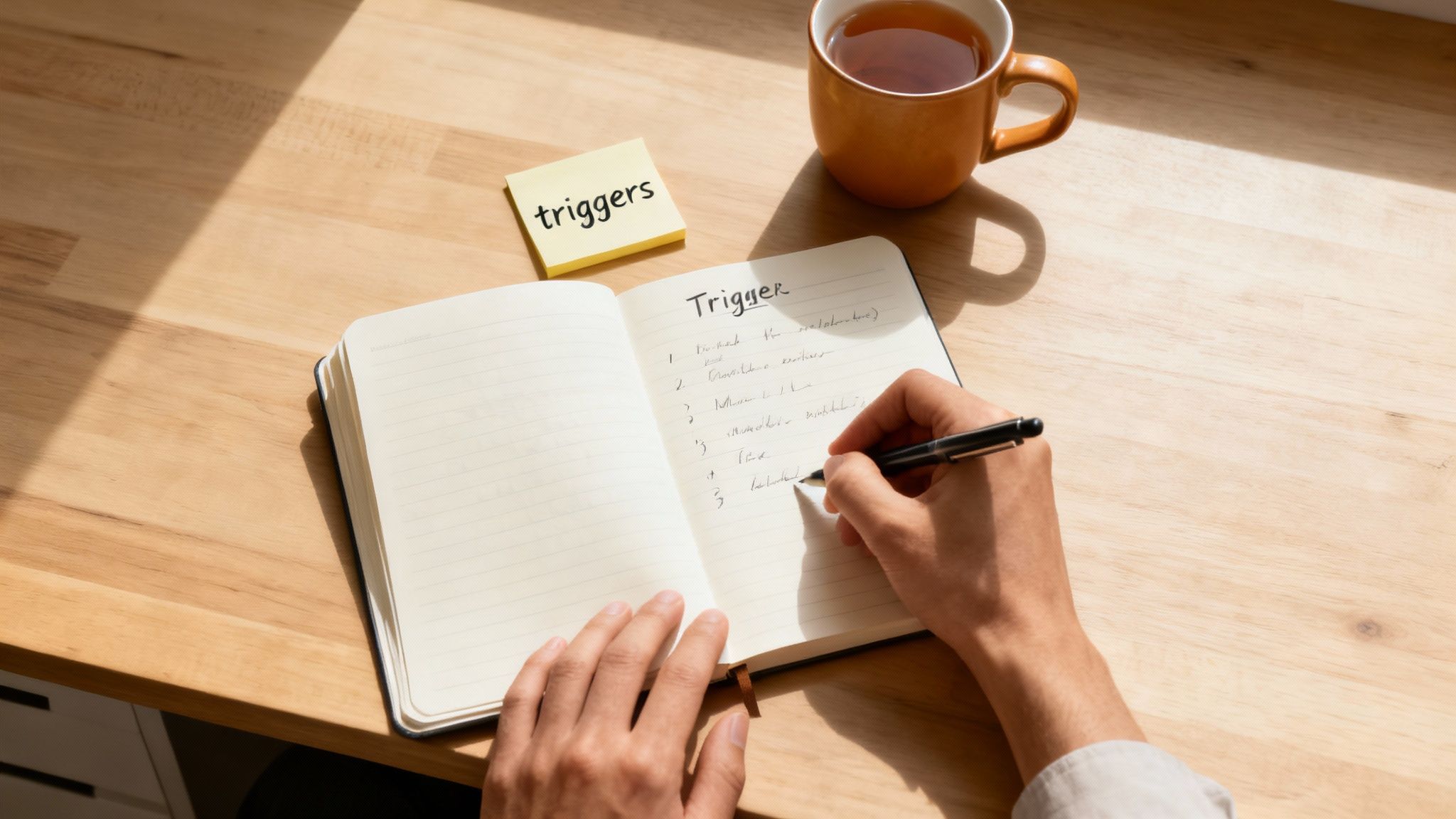
Overeating rarely just happens. It’s almost always a reaction, a coping mechanism kicked into gear by something else going on in our lives. To really get a handle on it, you have to put on your detective hat and start looking for clues. What specific situations, feelings, or even times of day seem to always come right before an episode?
This isn’t about blaming yourself. It’s about empowering yourself. Once you can see what lights the fuse, you can learn how to defuse it before the urge takes over. You’re essentially creating a personalized map of your own mind and habits.
Become a Habit Detective
For the next week or two, try keeping a simple journal. Don’t worry about calories or macros—this isn’t about judgment. It’s about gathering intelligence. Using a tool like the best food diary app can be a game-changer here, helping you see your habits more clearly.
Every time you eat, and especially when you feel you’ve eaten more than you wanted to, just jot down a few quick notes:
- What you ate: Just a quick summary is fine.
- When it was: The time of day can be a huge clue.
- Where you were: In the kitchen, at your desk, in the car? The environment matters.
- Who you were with: Were you alone? With a partner? A specific group of friends?
- How you felt emotionally: This is the big one. Be brutally honest. Bored? Stressed? Sad? Lonely? Even celebrating?
- Your physical hunger level (1-10): Was your stomach actually growling, or was this something else entirely? A 1 is starving, a 10 is painfully full.
This whole exercise is designed to help you pause and build the self-awareness you need to break that automatic cycle of trigger-to-urge-to-action.
Identifying Your Unique Patterns
After a week or so, take some time to read through your notes. I guarantee you’ll start to see some patterns emerge. It’s often an eye-opening experience.
Maybe you’ll realize that 9 PM boredom is your number one enemy. Or perhaps you’ll connect the dots and see that you always head for the pantry after a tense conversation with a family member. For others, it might be social events where the pressure to indulge feels overwhelming.
By identifying the why behind your eating, you can start addressing the real problem. If stress is the trigger, the solution isn’t a new diet—it’s developing healthier ways to manage that stress.
This awareness changes everything. You’re no longer fighting some mysterious, all-powerful urge. Instead, you’re facing a specific, predictable challenge you can prepare for.
To get started, check out this table of common triggers and think about what your own alternatives could be.
Common Overeating Triggers and Alternative Responses
| Common Trigger | Example Scenario | Healthy Alternative Action |
|---|---|---|
| Stress | You just finished a high-pressure work project and feel completely drained. | Go for a 10-minute walk, do some deep breathing exercises, or listen to a calming playlist. |
| Boredom | It’s late at night, the house is quiet, and you’re scrolling aimlessly on your phone. | Start a puzzle, pick up a book you’ve wanted to read, call a friend, or work on a hobby. |
| Sadness/Loneliness | You feel down after seeing friends’ happy posts on social media. | Journal about your feelings, watch a favorite comedy, or reach out to someone you trust for a chat. |
| Social Pressure | You’re at a party where everyone is snacking and drinking heavily. | Have a sparkling water with lime, focus on conversations away from the food table, or plan to stay for a shorter time. |
This table is just a starting point. Your triggers and solutions will be unique to you, but seeing common examples can help you recognize them in your own life.
As you get better at navigating these moments, tracking your progress can be incredibly motivating. Using a sobriety calculator for binge eating lets you see how many times you’ve successfully chosen a new response. Each success builds momentum and reinforces that you are, in fact, in control.
Master Mindful Eating to Regain Control
 Mindful eating isn’t another diet. Forget restriction. This is about learning to pay full, non-judgmental attention to your food and, more importantly, to your body’s own signals. It’s a powerful way to break out of that autopilot mode where we eat without even thinking, often consuming far more than we actually need.
The whole point is to shift from being a passive eater to an active participant in your own nourishment. It’s about slowing everything down. Did you know it takes about 20 minutes for your brain to get the message from your stomach that you’re full? By eating mindfully, you give that communication a chance to happen.
The Five Senses Check-In
Before you even pick up your fork, just pause. Take a second to ground yourself and really experience your food with all five senses. This simple act can transform how you approach your meal and is a cornerstone of learning how to curb overeating.
Start by just looking at your plate. What colors do you see? What about the textures and shapes? Now, close your eyes and take a deep breath through your nose. What aromas do you notice? Finally, when you take that first bite, chew slowly. Really focus on the taste and the feel of the food in your mouth.
Mindful eating is about rediscovering the pleasure of food. When you truly savor each bite, you often find that you’re satisfied with less, making it easier to stop when you’re comfortably full.
This level of awareness helps you enjoy your meal on a much deeper level, but it also gives your body the time it needs to send those “I’m getting full” signals before you’ve accidentally gone too far.
Practical Mindful Eating Exercises
Getting mindful eating into your daily routine doesn’t have to feel like a huge, complicated project. You can start small, with simple practices you can build on. Remember, we’re aiming for progress, not perfection.
Here are a few easy exercises to get you started:
- The Mid-Meal Pause: Halfway through your meal, just put your utensils down. Take a couple of deep breaths and check in with yourself. On a scale of 1 to 10, how full are you right now? This little pause can be the difference between stopping when you’re satisfied and stopping when you’re stuffed.
- Ditch the Distractions: Try to eat just one meal a day without any screens. That means no TV, no scrolling on your phone, no laptop. It’s just you and your food. You might be shocked at how much more tuned in you are to your body’s signals when you aren’t distracted.
- Switch Hands: This one sounds a bit silly, but it works. Try eating with your non-dominant hand. It’s an easy trick that forces you to slow down and makes every movement more deliberate. It physically breaks the habit of shoveling food in on autopilot.
Think of these exercises as tools for learning to listen to your body’s own wisdom again. The more you practice, the more second nature it becomes. You’ll start to recognize your fullness cues without even thinking about it, turning meals back into a source of nourishment and enjoyment, not a struggle.
Riding the Wave: Practical Ways to Manage Food Cravings
Food cravings, especially in recovery, can feel like a tidal wave—sudden, intense, and completely overwhelming. But here’s the thing about waves: they always break. They build, they crest, and then they recede. Learning how to navigate these urges without getting swept away is a skill. And like any skill, the more you practice, the stronger you get. The goal isn’t to pretend cravings don’t exist; it’s to build the confidence that you can handle them when they show up.
This isn’t just a personal struggle. The conditions often linked to overeating have a massive societal footprint. The global economic cost of obesity is staggering, estimated to be over $2 trillion a year—that’s about 2.8% of the entire world’s GDP. You can discover more about these global economic impacts to get the bigger picture. It just goes to show how vital it is to develop personal strategies that actually work.
Try “Urge Surfing”
One of the most powerful techniques I’ve seen work for people is called urge surfing. It sounds a bit strange, but the concept is simple. Instead of fighting the urge or immediately giving in, you just observe it. Get curious. Acknowledge the feeling without judging yourself for having it.
Notice where you feel it in your body. Is it a knot in your stomach? A specific taste in your mouth? By simply observing the craving, you create a tiny but critical gap between the feeling and your reaction. You’ll start to notice a pattern: the urge builds, it hits a peak, and then it naturally starts to fade away all on its own. It’s an incredibly empowering feeling when you realize you don’t have to obey every single urge.
Master the “Delay and Distract” Move
Another go-to tool is the “delay and distract” method. It’s incredibly straightforward. When a craving hits you hard, make a deal with yourself. You can have the food, but not right now. Just wait 20 minutes. This simple act of pausing shatters that automatic, impulsive cycle that cravings thrive on.
So, what do you do for those 20 minutes? You get busy.
- Get moving: A quick walk around the block can work wonders.
- Engage your brain: Call a supportive friend, put on an interesting podcast, or tackle a crossword puzzle.
- Change your scenery: Just stepping outside for a minute or moving to a different room can shift your focus.
More often than not, by the time the 20 minutes are up, the craving has either vanished or lost most of its power. You’ve successfully surfed the strongest part of the wave.
Cravings are temporary signals, not commands. Creating a brief pause before you act gives your rational mind a chance to catch up with your emotional impulse.
Set Up Your Kitchen for Success
Your environment has a huge say in how well you manage overeating. If your cupboards are overflowing with your biggest trigger foods, you’re basically signing up for a constant, draining battle of willpower. You have to rig the game in your favor.
This isn’t about banning everything you enjoy. It’s about making the healthy choice the easy choice.
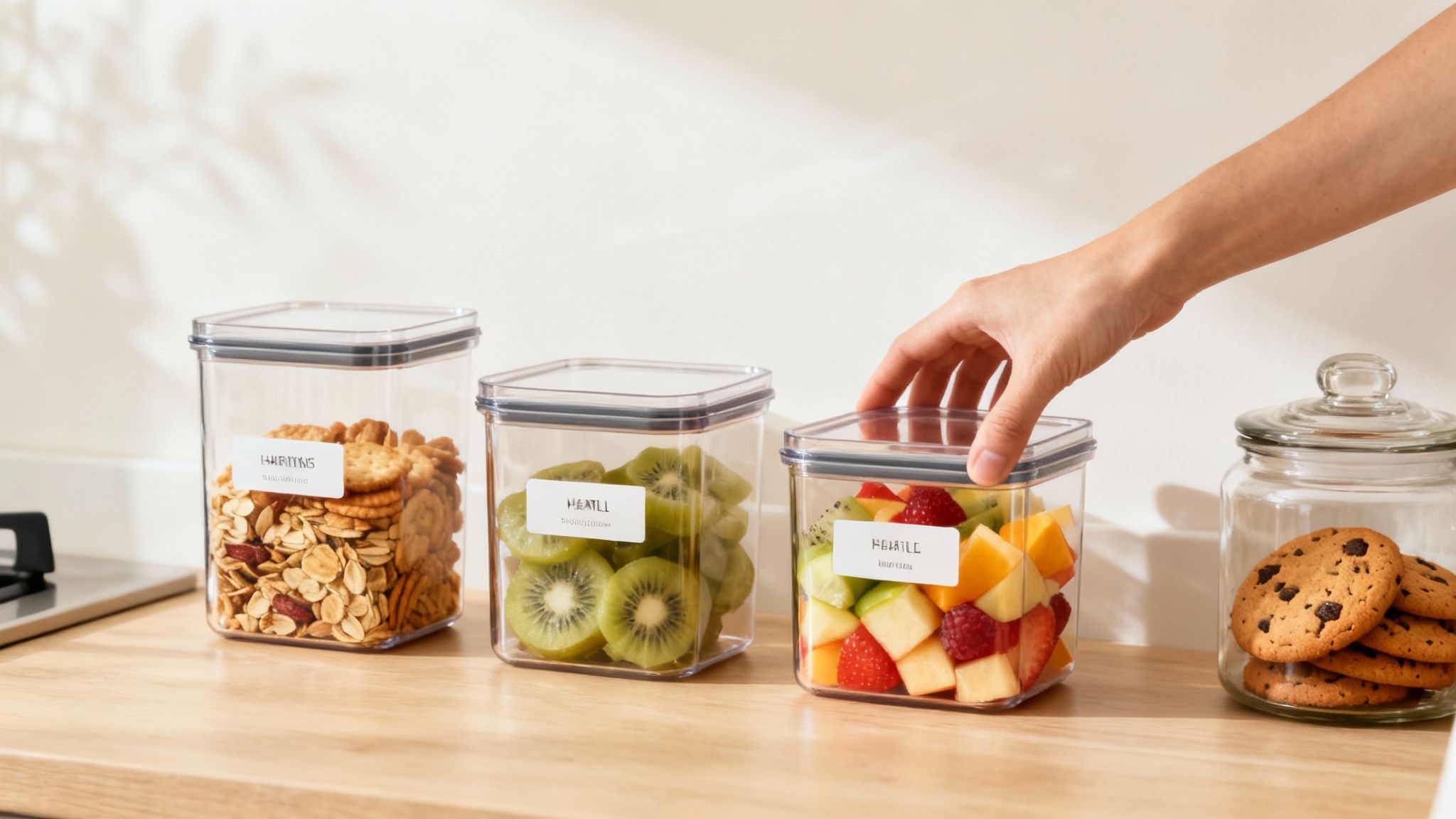
- Out of sight, out of mind: Keep tempting foods in opaque containers on a high shelf or way in the back of the pantry. Don’t leave them out where you’ll see them all day.
- Make healthy visible and easy: Put a big bowl of fresh fruit on the counter. Keep pre-cut veggies and hummus at eye level in the fridge.
- Plan for snack attacks: Have satisfying, smarter snacks ready to grab. Think Greek yogurt, a small bag of almonds, or an apple with a spoonful of peanut butter.
When you structure your environment this way, you take the pressure off your willpower. It becomes easier to grab something that supports your goals when an urge pops up. You can even use a tool like this sobriety calculator for sugar intake to track your wins and see how those small, positive choices really add up over time.
Build a Meal Structure That Prevents Overeating
When you’re starving, all rational thought goes out the window. It’s a primal feeling, and in that moment, the fastest, easiest, most calorie-dense option feels like the only option. This is reactive eating, and it’s a huge pitfall when you’re trying to build a healthier relationship with food. The most powerful way to counter this is to get proactive with a solid meal structure.
This isn’t about a rigid diet or obsessively counting calories. It’s about creating a predictable rhythm for your body. When you plan your meals and snacks, you’re not just deciding what to eat; you’re giving your body a steady stream of energy, keeping your blood sugar stable, and taking the mental load off of making food choices in the heat of the moment.
A consistent eating routine provides a powerful sense of security and stability. When your body trusts that it will be fed regularly, the panicked, urgent sense of hunger that often leads to overeating begins to fade.
Learning some simple strategies on how to plan weekly meals can be a game-changer. You don’t have to be a master chef; even small steps like pre-chopping veggies or cooking a big batch of quinoa on Sunday can make all the difference during a hectic week.
The Building Blocks of a Satisfying Meal
If you want to stop overeating, your meals have to actually be satisfying. A sad, flimsy salad might check the “healthy” box, but if you’re hungry again an hour later, it’s not doing its job. The secret is to build balanced plates that keep you feeling full and energized for hours.
Think about including these three key players in every meal:
- Lean Protein: This is your staying-power ingredient. Things like chicken, fish, tofu, beans, or even Greek yogurt are fantastic because they’re incredibly satiating.
- High-Fiber Carbohydrates: Forget the crash-and-burn from sugary carbs. We’re talking oats, brown rice, quinoa, and whole-wheat bread. These provide a slow, steady release of energy.
- Healthy Fats: Avocado, nuts, seeds, and a drizzle of olive oil do more than just add flavor. They slow down digestion, which is another key to extending that feeling of fullness.
This simple formula is a blueprint for meals that are not only good for you but also genuinely keep hunger at bay. When your meals are truly satisfying, you’ll find you’re far less likely to go hunting for snacks in between.
Designing Your Daily Eating Rhythm
Everyone’s schedule is different, so your ideal eating rhythm will be unique to you. That said, a great starting point for many people is to eat something every three to four hours. This steady intake prevents you from ever getting to that “primal hunger” state where mindful choices feel impossible.
A typical structure might look something like this:
- Breakfast: Go for something protein-rich to set a strong foundation for the day.
- Mid-Morning Snack: This helps bridge the gap between breakfast and lunch, keeping your energy stable.
- Lunch: A balanced plate with a mix of protein, fiber, and healthy fats.
- Afternoon Snack: The perfect way to head off that late-afternoon energy slump.
- Dinner: Another satisfying, balanced meal to round out the day.
As you start to put this new routine into practice, seeing your progress can be a huge motivator. Our sobriety calculator for junk food consumption is a great tool for this. It helps you visualize how all these small, positive choices are adding up, which can really reinforce your commitment to building a better relationship with food.
Common Questions About Overeating
When you start working on your relationship with food, a lot of questions are bound to come up. It’s completely normal to feel a bit lost when you’re trying to undo habits you’ve had for years. Having a game plan for those common hurdles can be the very thing that keeps you moving forward.
Remember, this journey isn’t about being perfect. It’s about being persistent. Let’s dig into some of the questions I hear most often and give you some real, practical answers.
How Do I Handle Social Situations?
Ah, the social gathering. Parties, dinners out, family get-togethers—they can feel like a total minefield when you’re trying to eat consciously. The pressure, both internal and external, to just eat and drink what everyone else is having is a real thing. The trick is to walk in with a strategy so you’re in control, not just reacting to your surroundings.
I always suggest having a small, protein-packed snack before you even leave the house. Showing up to an event absolutely starving is a recipe for disaster; it’s just too hard to make thoughtful choices when your hunger is screaming at you.
Once you’re there, a few simple moves can make a world of difference:
- Do a quick scan. Before grabbing a plate, take a lap and see what’s on offer. Make a mental note of what looks genuinely appealing, rather than just piling on the first thing you see.
- Pick your spot. It sounds simple, but physically standing away from the buffet table or the bowl of chips really does curb mindless grazing. Position yourself where the conversation is the focus, not the food.
- Keep a drink in hand. Holding a seltzer with lime or a cup of tea does more than just hydrate you. It keeps your hands busy and can fend off the urge to constantly reach for a snack.
What Should I Do If I Have a Setback?
First off, just breathe. One instance of overeating is not a failure. It’s just information. The absolute worst thing you can do is let it spiral into a cycle of guilt and restriction, because that nearly always leads right back to another binge.
Instead of beating yourself up, get curious. What was going on right before it happened? Were you feeling super stressed? Did you let yourself get too hungry earlier? Pinpointing the trigger is so much more powerful than drowning in guilt. Acknowledge it, learn what you can, and get right back to your plan with your very next meal. No drama needed.
One off-plan meal won’t undo your progress. But a week of negative self-talk and “making up for it” definitely can. How you respond to the slip-up is what truly matters.
How Long Does It Take to Build New Habits?
Everyone wants to know this, and the honest-to-goodness answer is: it’s different for everyone. You’ll see studies that throw around an average of 66 days for a new behavior to feel automatic, but the reality is that it can be anything from a few weeks to many months. It really depends on the person and the habit you’re trying to build.
What’s far more important than speed is consistency. Every single time you choose a new action—whether it’s pausing to check in with your hunger mid-meal or going for a walk when you feel an urge—you’re literally carving out new pathways in your brain.
Try to see it less like a sprint to a finish line and more like a quiet, steady process of becoming a version of yourself you’re proud of. Don’t forget to celebrate the small wins. Each one is a solid brick in the foundation of lasting change.
Ready to build that consistency with a tool that has your back? Soberly gives you the features you need to track your progress, celebrate milestones, and build healthier habits day by day. Download the Soberly app to get started.
Related Topics